Introduction
Managing human resources is essential for every business, but small and medium enterprises (SMEs) may not have the time, budget or internal expertise to manage every HR function independently. From employee documentation and attendance tracking to payroll coordination and recruitment, HR responsibilities can take valuable time away from core business activities.
HR outsourcing for SMEs in India offers businesses an option to delegate selected HR activities to an external service provider. Depending on the arrangement, companies can access professional support for routine HR administration, recruitment coordination and employee documentation without building a large in-house HR department.
In this guide, we explain the benefits, common services, cost considerations and situations in which HR outsourcing may make sense for your business.
What Is HR Outsourcing?
HR outsourcing means engaging an external provider to manage specific human resource activities or support an organisation’s broader HR operations.
Instead of handling every administrative task internally, a business can outsource selected functions based on its requirements, workforce size and budget.
For example, a growing company might manage employee relations internally while outsourcing payroll processing support, recruitment coordination or employee record management.
HR outsourcing for SMEs in India can be arranged as a limited service, a recurring monthly engagement or a broader HR support agreement. The exact scope depends on the provider and the contract.
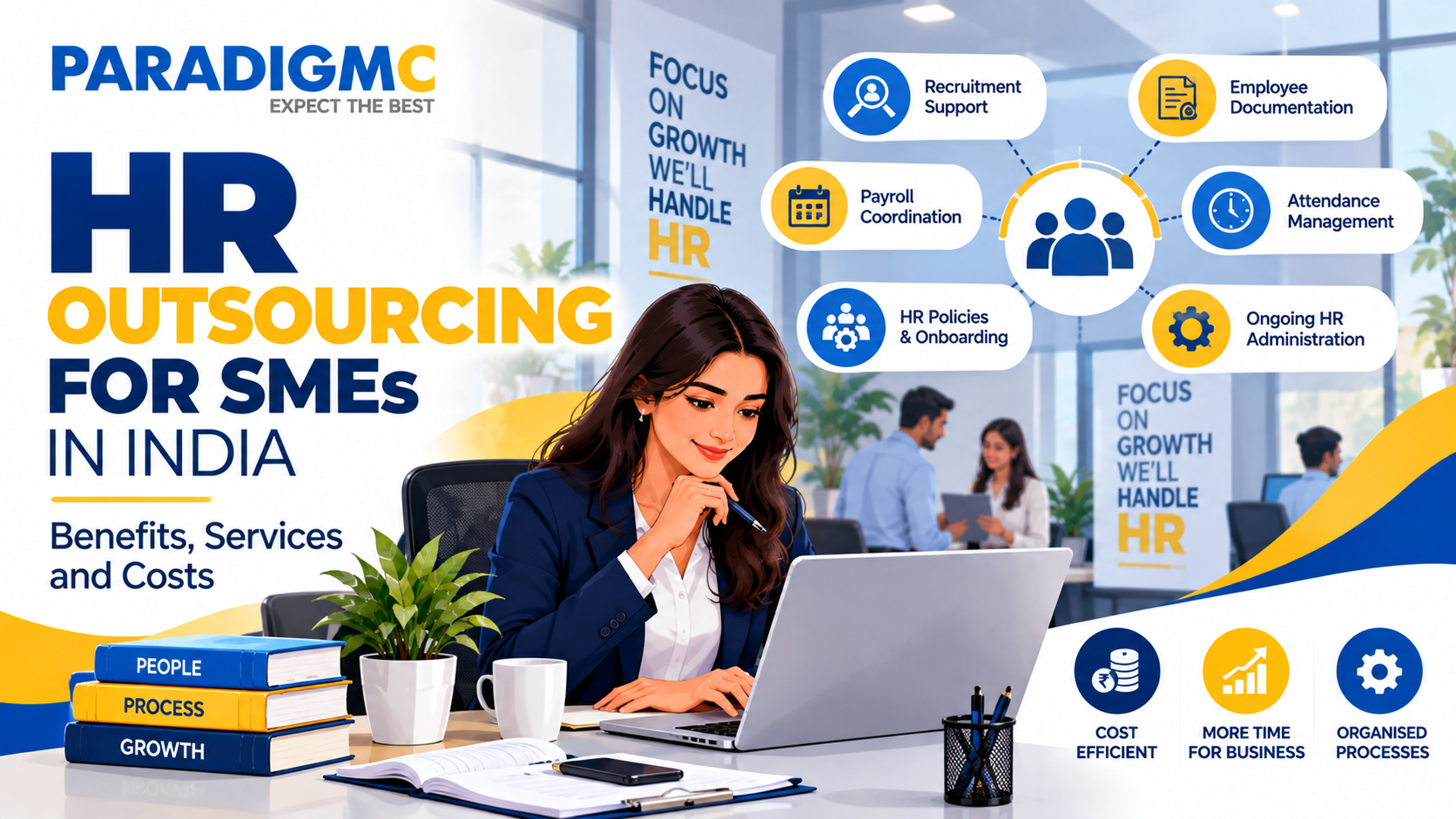
Key HR Outsourcing Services for SMEs
1. Recruitment and Hiring Support
Recruitment involves preparing job descriptions, sourcing candidates, screening applications, coordinating interviews and communicating with applicants.
External recruitment support can help businesses manage hiring requirements while internal managers focus on evaluating candidates and making final selection decisions.
2. Employee Documentation and Records
Maintaining organised employee records is important for day-to-day HR administration. Support may include joining documents, employment records, appointment letters, policy acknowledgements and employee file management.
Businesses should establish clear procedures for access, confidentiality, document retention and secure storage.
3. Payroll Coordination
Payroll processes require accurate employee information, attendance data, salary components, approved deductions and timely processing.
An HR outsourcing provider may coordinate payroll inputs, maintain records and work with the employer’s payroll or accounting team. Confirm whether actual payroll processing, statutory calculations, filings or payment administration are included in the agreed service.
Employers remain responsible for understanding their legal obligations and ensuring that the overall process meets applicable requirements.
4. Attendance and Leave Management
Attendance and leave administration can become complicated as teams grow or operate across multiple locations.
Outsourced HR support may include maintaining attendance records, tracking leave balances, collecting manager approvals and preparing reports for payroll coordination.
Clear rules for shifts, overtime, leave approvals and attendance corrections help minimise errors.
5. HR Policies and Employee Onboarding
New employees need clear information about workplace policies, reporting structures, responsibilities and administrative procedures.
External HR support may help prepare onboarding checklists, coordinate joining formalities and maintain policy documentation. Businesses should ensure that all policies reflect their actual operations and applicable legal requirements.
6. HR Administration and Reporting
Recurring HR administration may include maintaining employee databases, preparing workforce reports, tracking probation dates and coordinating routine HR communications.
Depending on the arrangement, a provider may also help identify administrative gaps and recommend process improvements.
Benefits of HR Outsourcing for SMEs in India
Better Use of Time
Delegating repetitive administrative work can allow business owners and managers to focus more on customers, operations and growth.
Flexible HR Support
A company may outsource only the activities it needs rather than immediately building a large internal HR team. Services can potentially be adjusted as business requirements change.
More Organised Processes
Defined workflows for documentation, attendance, onboarding and payroll coordination can improve consistency and make information easier to retrieve.
Access to Specialist Support
External providers may bring experience in recruitment coordination, HR documentation and administrative processes that a small business has not yet developed internally.
Support During Business Growth
When a business expands, HR administration often becomes more demanding. HR outsourcing for SMEs in India can provide additional operational support while the company evaluates which functions it should eventually manage in-house.
Outsourcing does not automatically guarantee compliance, cost savings or improved employee satisfaction. Results depend on the provider’s capabilities, the service agreement and the employer’s oversight.
How Much Does HR Outsourcing Cost in India?
There is no single standard price for HR outsourcing. Costs vary according to the services included, employee headcount, number of locations, transaction volume and complexity of the work.
Common pricing models include:
- Monthly retainer: A recurring fee for an agreed set of HR services.
- Per-employee pricing: Charges calculated according to the number of employees supported.
- Project-based pricing: A fixed fee for a defined task, such as creating HR documentation or setting up an onboarding process.
- Service-specific pricing: Separate charges for recruitment, payroll coordination or other individual services.
Before comparing quotations, ask providers to specify the deliverables, service limits, additional charges, reporting arrangements and contract duration.
A lower headline fee may not represent better value if important services are excluded or charged separately.
When Should an SME Consider HR Outsourcing?
HR outsourcing may be worth considering when:
- Business owners spend too much time on routine HR administration.
- Employee documentation is inconsistent or difficult to maintain.
- Recruitment needs are increasing.
- Attendance and payroll inputs require better coordination.
- The business is opening another office or operational location.
- The company needs HR process support but is not ready for a larger internal team.
Businesses with complex employee relations issues or highly specialised compliance requirements may still need dedicated internal expertise or professional legal and compliance advice.
How to Choose the Right HR Outsourcing Partner
Before signing an agreement, evaluate the provider carefully.
- Define the scope: List the exact HR activities you want to outsource.
- Check relevant experience: Ask about experience supporting businesses of a similar size or industry.
- Clarify responsibilities: Establish who handles approvals, employee queries, payroll inputs and statutory obligations.
- Review data security: Understand how employee records are stored, accessed and shared.
- Compare total costs: Request a written quotation that identifies included and excluded services.
- Agree on reporting: Establish timelines for updates, reports and issue resolution.
- Review exit terms: Confirm how records will be returned and services transitioned if the agreement ends.
A clear service agreement helps prevent misunderstandings and establishes accountability for both parties.
HR Outsourcing Support from Paradigm Consultancies
Paradigm Consultancies provides recruitment and HR services to businesses in Nashik. Companies can contact the team to discuss their recruitment requirements and clarify which HR support services may be available for their needs.
If your business is spending too much time managing recruitment or employee administration, start by identifying the activities that create the greatest workload. You can then compare internal processes with the scope and cost of external support.
Contact Paradigm Consultancies
- Website: https://paradigmc.in/
- Email: info@paradigmc.in
- Phone: +91 88088 79039
- Location: Indira Nagar, Nashik, Maharashtra
Contact the team to discuss your business requirements and confirm the available services, deliverables and commercial terms.
Frequently Asked Questions (FAQs)
1. What is HR outsourcing for SMEs in India?
HR outsourcing for SMEs in India means engaging an external provider to manage or support selected HR activities, such as recruitment coordination, employee documentation, attendance administration and payroll-related processes.
2. Which HR services can small businesses outsource?
Depending on the provider, businesses may outsource recruitment support, onboarding coordination, employee record management, attendance tracking, payroll coordination and routine HR administration.
3. Is HR outsourcing suitable for a small business?
It may be suitable when the business has recurring HR tasks but does not need or cannot justify a larger internal HR team. The decision depends on workload, budget, complexity and the services available.
4. How much does HR outsourcing cost in India?
Costs depend on the scope of services, workforce size, locations, complexity and pricing model. Request a written quotation rather than relying on a universal rate.
5. Does HR outsourcing include payroll processing?
Not always. Some agreements cover payroll coordination or preparation of attendance and salary inputs, while others include broader payroll services. Confirm exactly what is included.
6. Can HR outsourcing help with recruitment?
Yes, some providers offer recruitment support, including candidate sourcing, screening and interview coordination. Confirm the roles, hiring volume and recruitment deliverables covered by the agreement.
7. Does outsourcing HR transfer all legal responsibilities to the service provider?
No. Responsibilities depend on the applicable law, employment arrangement and contract. Employers should clarify accountability and obtain appropriate professional advice for their compliance obligations.
8. How do I choose an HR outsourcing provider?
Compare service scope, relevant experience, pricing transparency, data security, communication, reporting and contract terms. Ask for written details before committing.
Conclusion
HR outsourcing for SMEs in India can help businesses organise routine HR activities, access external support and manage growing administrative demands. The best arrangement depends on which tasks need support, the provider’s capabilities and the total cost.
Start by reviewing your current HR workload, identifying gaps and defining measurable service requirements. A clear plan will help you decide whether outsourcing is the right option for your business.